Occasional writings from Rev.Karen L. Munson, pastor of the United Methodist Church Brunswick.
Tuesday, March 30, 2010
In Our End is Our Beginning
Coming to the end of Jonah's story, I couldn't help but notice that it looked more like a beginning. It's open, unresolved. How would you write the end of Jonah's journey with God (Jonah 4)? Has he reached the end of his resistence....or will he make another dash for it!?
We tend to like our stories to end happily. We live in a culture that, as Matthew Fox puts it, "tends to define happiness as absense of suffering." So, he continues, "we strive to invest our creative powers in building temples to security, whether they be the immortal marriage, the immortal job, the immortal corporation or the immortal skyscraper to house that corporation, or the immortal Nations with its invincible army and weaponry."
No wonder we put off encountering the suffering and death Holy Week's scripture heads us towards. There's a lack of security in the notion that the Messiah, much less God, could die.
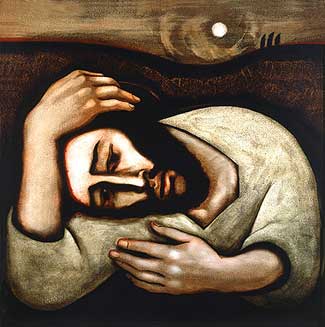
(Jacob Stienhardt's "Jonah") Does happiness =absence of suffering?
What is the end of life, the goal we live for?
Fox goes on to share Pierre Boulez's definition of what life is about. "The goal of life is not happness (aka security); it is living." And living, both the gospel and Fox remind us, implies suffering. "In fact, the creative person--and that hopefully is all of us--takes on additional burdens of suffering by entering fully into living." (A Spirituality Called Compassion).
When the ancient Greek philosophers and early Church theologians talked about life's end, they meant end as "telos," the purpose God plants in our life, what organizations and gives structure to our life. It is our reason for being, what we are aimed at. If we are pursuing the avoidance of suffering, then defense is our structure. If we aim at the alleviation of pain, sin, death, then our purpose draws us through rather than around suffering.
So in Jesus' end he suffers.
It is in the end of that great suffering that he encounters God's greatest mercy-God's life.
God's very being is mercy. The mercy of God lies in God's readiness to share in sympathy the distress of another, a readiness which springs from God's inmost nature and stamps all with God's being and doing...And this, of course, is why we are able to face, acknowledge, accept and live through suffering, for we know that it can never be found ultimate, it can never constitute the bottom line. God is at the foundation and God is at the boundaries. (Eugene Petersen, A Long Obeidience in the Same Direction).
The walk we imagine Jesus on this week is a walk toward God's ultimate end, toward the mercy full bottom line.
A prayer of Confession for the early days of Holy Week
Loving, Living, Gracious God,
we confess that we fear suffering,
not just for ourselves, but for those we love.
We point fingers at those we blame,
the ones over there,
the ones in here,
ourselves.
But you would push those pointing hands down,
asking us, as they go lower, lower,
what our deepest need really is.
Offering to show us,
while we're down there,
what our deepest gift is as well.
We confess that we are reluctant to let those gifts be loosed in your service.
What if they break? What if we misuse them?
Forgive us for underestimating ourselves,
our capacity for wrong,
and our capacity for right.
Unclench the fists we close.
Open our palms up
and up and up
to receive your gifts:
assurance
faith
peace.
Monday, March 22, 2010
How does God Know?
What a wonderful and important question!!! In some ways it's a question more important than potential answers, a question older than Christianity. In fact, its a question that begs more questions. What assumptions lie underneath? The question seems to ask whether God is free to change or eternally unchanging. If God knows how it all turns out in the end, how can the path to the end change?
Assumption #1
When we say"know" we assume we mean a firm grasp of creations facts and narrative arch. But the Hebrew word know is relational, as a mother knows an infant or a married couple knows each other, emotionally, phyically, intimately.
Assumption #2
When we say, "the end," we mean the period at the end of a cosmic sentence, the last chapter, a finale (grand or not). Early Christians, influenced by Aristotle, used "end" as telos, fulfillment of purpose.
Assumption #3
We tend to assume that God experiences time the same way we do. After all, Jesus Christ, our window to God, entered our time and space. We know God in our time, in our experience. And in modern western culture that means in our past, present, and future. Time forms a linear movement, one thing leads to another. So....if (using our assumed meanings) God knows the end of the story, its hard to see how God can change God's mind. The outcome iteself would change like the path of a ribbon waved in a new direction.
What if God is unlimited by our linear time? What if this arc of past, present future is dancing in something fuller, of infinite dimension..... in God? Other cultures, and theories of physics, conceive of time as non-linear. Perhaps God holds (knows, creates) all that makes fullfillment of God's purposes possible. Perhaps when something happens in our lives, the linear idea that God might have known it was going to happen is less important than the eternal knowledge that God will help us make something awesome out of it, something that serves love.
Perhaps when we read Jonah's story, we're confused because our assumptions are like the tail trying to wag the dog!
Monday, January 18, 2010
half alive?
It hits me right in my complacency.
Here's another one, I love the recklessness of faith, first you leap, and then you grow wings. (Wiliam Sloane Coffin). Couldn't the wings grow first? I mean, what kind of faith asks me to risk leaping before I can either see the ground or know I'll fly?
It seems like restless faith that asks me to trust other people to toss their gifts in the ring without knowing whether they'll follow through. If any one part of " fails to follow through.......what a mess.
Maybe we should all hold hands, count to three and jump together, ready......? The think system isn't going to work here. We have to really "do it."
Do what? Stop living half alive. Get troubled, resurrection faith style. Sprout wings.
If you've patient enough to let it load, this movie, "The Butterfly Circus" shows better than I can tell!
Wednesday, January 13, 2010
What Year is it (again?)
Hmmm, wonder what I was thinking.....
Then I got thinking about how lots of folks think that churches live in the past. Its an understandable notion. We read a book of material edited into its present collection alomst two thousand years ago. Around here, we usually worship in buildings built 100-200 years ago.
(Pop quiz-Do you know how old the Torsey Church will be by the fall of 2010?)
Then again, some folks think of Christian lives as oriented to a distant future, an end time, or life after death.
In the church, we find ourselves living in the "not quite there" time. We find inspiration and guidance from what God has done in the past. We find hope for what God has promised for the future.
But if I think of it as just a time line, I feel "all strung out," neither here nor there. But, if I remember its not so much that God is pushing and pulling us through human time, but enfolding us in God's own eternal time, then I find the place where I can both rest in God's mercy and be challenged by God's justice.
Monday, December 14, 2009
12-13-09 “The Shepherd’s Way Home”
Imagine one listening in that crowd around John the Baptist.
a shepherd.
Like Abel, Adam and Eve’s second born,
the first slaughtered,
by his firstborn farming brother.
His father trusts him,
that’s why he’s put in charge of the valuable flocks,
flocks that provide wool for homes and trade, clothing, milk, meat,
dung for fuel, hides for scrolls.
Little economic engines bleating all over the hills of Galilee.
Was he lured in by the urgency of John’s words,
the intensity of the crowd’s listening,
Had he ever been part of a group of people so transfixed in listening?
At first, perhaps the people appeared almost smug,
people in the know,
hearing what they expected.
“Children of Abraham,” calling out
“tell us a story, John, tell us what God will do for us.”
But the story John told came with a twist,
a love story, yes,
but barked back with a bite.
“Who do you think you are?
You think that because your ancestors followed the Good Shepherd
you can wander anywhere you want and call for room service?”
(My imaging works in Twenty first century vocabulary).
God doesn’t deliver on demand.
Why, If you disappeared,
God could raise a new flock right out of those rocks under your feet.” You tie your lives in knots
and yell at God for not untying them,
WHO –DO- YOU- THINK- YOU- ARE?”
John seemed to reach into their lives, to know their thoughts, their past,
to grab their every need in his fists.
His words reaching an impassioned edge,
straining against the limits of civil discourse,
but held in check by a rein of love.
“What then should we do?” murmured through the crowd,
“what should we do?”
John’s prophetic words tumbled over and through them,
Prophetic words, harvested from his people’s history,
The shepherd might have remembered that long age,
Moses,
who spent his exile as a shepherd,
used those skills to lead his people like a flock through the wilderness, traveling at the pace demanding by real sheep.
They couldn’t leave them behind.
they’d need them in a new home, in the new land.
He might have remembered
David,
The shepherd boy turned king
who forgot the needs of his flock
and had to be called back to accountability by God’s prophet, Nathan.
A shepherd’s responsibility is to protect the sheep,
not become a wolf among them.
David fell and fell hard
And yet, when he heard the word of the LORD,
What should I do LORD, what should I do,
remembered who he was, whose he was, and found his way home.
This shepherd, listening to John,
was taking quite a chance,
leaving his flock on their own while he followed the mesmerized crowd,
gripped by the hold John’s words had on his audience.
Those words carried an urgency
on which seemed to hang the balance of the world.
“What should we do? What then should we do?”
Looking at each other in confusion, looking at John for guidance,
This shepherd heard the people on all sides ask, “What should we do? “
John’s answer, “You know what to do. Take care of each other.
If one of you needs a coat and one of you has two coats, you know what to do. If one of you has food and others are hungry, you know what to do. Do everything in your power to take care of each other.
“Take care of each other as well as, or better than,
you steward your flocks, your business, your households.”
John’s eyes met each person in the crowd, one by one by one, each man, each woman. When he looked into the young shepherd’s eyes, it was as though his own brother was looking at him.
Did John say it out loud, or did his own mind supply the words,
When was the last time he talked, really talked to his brother,
in the way that lets each other know what your life is about,
what you really need?
And why had he hidden that extra loaf of bread last week
when the scroungey looking fellow ambled down the road,
looking hopefully his way?
The shepherd knew what it felt like to be hungry,
but he also knew he’d never starve. He was part of a family.
All he had to do, whether it was near or far, was go home.
He heard others begging John,
each voice more desperate for relief than the last.
He heard the tax collectors ask, “what should we do?”
Johns’ answer, “You know what you should do. Collect just what those folks really owe, their fair share, no more.”
He heard soldiers, soldiers (!) ask like little children, “What do we do? What should we do?”
John’s answer, “You know what to do. Don’t misuse your power on those you are to protect. Don’t coerce them.
Don’t extort money from them, for God’s sake!
Don’t accuse them of things you know they didn’t do,
just to make your job easier or entertaining.”
He watched the soldiers,
Roman soldiers,
Israeli Soldiers,
temple guards,
shake their heads as if coming out of a deep sleep,
look around at the everyday people all around them,
see the people’s faces as if for the first time.
Sheep go astray. They wander. They follow false trails.
When they realize they are lost, they call for their keeper.
When they hear his voice, then they know they are home.
“What should we do, what should we do?”
Should we follow you, John?
Their voices turned to expectation, to hope.
“No, not me, watch for the one who is coming after me.”
He seemed on the verge of adding, “idiots,”
but something, someone (?), who he stopped and listened to,
gentled him, like a sheep being coaxed into the fold.
Might this shepherd who we are imagining
have heard strange rumors when he was a child in Bethlehem,
the shepherds’ town, the little city of David.?
Strange rumors of shepherds, who’d seen angels,
and heard songs in the heavens, a cosmic symphony of praise.
Sheep go astray.
He was startled to remember his own flock, those in his own keeping.
What is a man?
So much of what we are is determined by the responsibilities we accept, the responsibilities put in our keeping.
We are given the power to lead and care for,
and we are given the power to choose who to follow,
who to be cared for by.
The Good Shepherd led him home to who he was, a keeper of flocks.
…led him home to who he was, kept in the heart of the Good Shepherd.
This is how we prepare, this is the Good News, John said,
and the shepherd heard that there is a way home.
With the multitudes that day, he went down to the river
and was baptized by John, turned around, washed clean, dunked down, and came up with a gasp of recognition. “God, you are my God,
I make my home in you,
I look for your redeemer’s coming to be my Shepherd”
And he went back to his flock, patting them and calling them, each of them, one by one, and went back into the hills. As he passed others in the human flock around him he saw others of the same household of God, going back to the work God gave them, but expecting that nothing would be the same.
---------------------------------------------------
New Interpreter’s Bible Dictionary, “Sheep,” “Shepherd”
Anchor Bible Dictionary Volume 5, “Sheep, Shepherd,” Jack W. Vancil.
Wednesday, December 9, 2009
Two Parents Talk
Where to begin?
I'm Zechariah, of the house of Abi-jah. My name means, "Yahweh remembers."
I have worked hard to keep the commandments and ordinances of the LORD and am recognized as a priest in our small town, though I sometimes forget myself. I'm not needed at the temple in Jerusalem very often.
My fine wife, Elizabeth, and I have been blessed with a comfortable life and many friends.
I had become content in my life...
but not fulfilled.
One thing was missing.
ELizabeth and I had no children.
Noone to continue my family name.
We had wished for a child, perhaps even a son, for so long without success. I had given up.
Now we were old with no chance for a child.
It should have been enough to be contented without being fulfilled.
Sunday, November 29, 2009

You never quite know what's going to happen when you plant something. Several years ago I rescued two sad sprigs of Christmas cactus from the Christmas fair remnants. This morning it bloomed in bushy glory by the altar. Advent is about expecting, but now being sure what you'll get!